Welcome to the course. Before we install anything or write a line of code, it is worth a few minutes to understand what Go is, where it came from, and why it has become one of the default choices for building backend services. If you can already write a bit of code in some other language, you are exactly who this course is for, and by the end of this chapter you will know why Go is a smart language to learn next.
This is a no-code chapter. We are setting the stage. From the next section onward we get hands-on.
Go was created at Google around 2009 by Rob Pike, Ken Thompson, and Robert Griesemer. These were not newcomers. Thompson co-created Unix and wrote B, the language C grew out of; Pike worked on Unix and Plan 9. They built Go to fix problems they were living with every day on Google's enormous codebases.
The two big frustrations were slow builds and complexity. When a project grows to millions of lines and hundreds of engineers, a few things start to hurt:
Go's answer was to stay small on purpose. It compiles fast, it has a deliberately tiny set of features, and it pushes everyone toward writing code that looks roughly the same. The goal was a language that a large team could read, build, and maintain without friction. That focus on simplicity is the thread that runs through everything in this course.
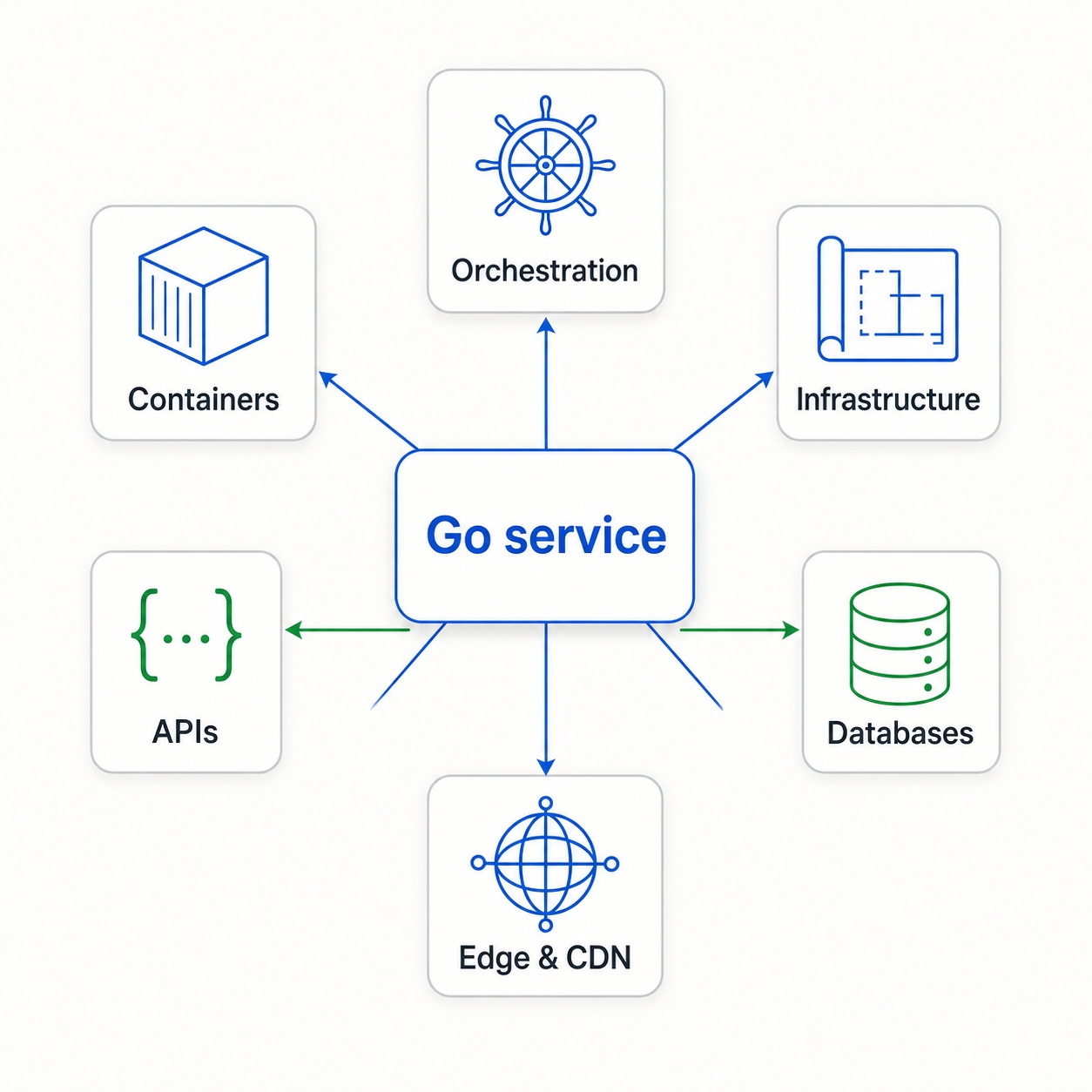
Go did not stay inside Google. It turned out to be a great fit for the kind of software that runs the modern internet: network services, command-line tools, and cloud infrastructure. A lot of the tools you may already use are written in Go.

A few you have probably heard of:
These are not small side projects. They sit at the center of how companies build and run software today, and they are all written in Go. Go also shows up constantly in APIs, microservices, and the high-traffic backends behind apps you use every day.
That popularity follows through to hiring. Companies like Google, Uber, Cloudflare, and Stripe build core systems in Go, and the broader job market for Go backend developers is healthy and growing. Learning Go is not only a good way to build real services; it is a practical career move.
Plenty of languages can build a backend. So why start with Go? A few reasons matter most when you are learning.
It is small enough to learn quickly. Go has around two dozen keywords and very little hidden machinery. There is usually one obvious way to do a thing rather than five competing ones. That means less to memorize and less to second-guess, so you spend your energy on building rather than on language trivia.
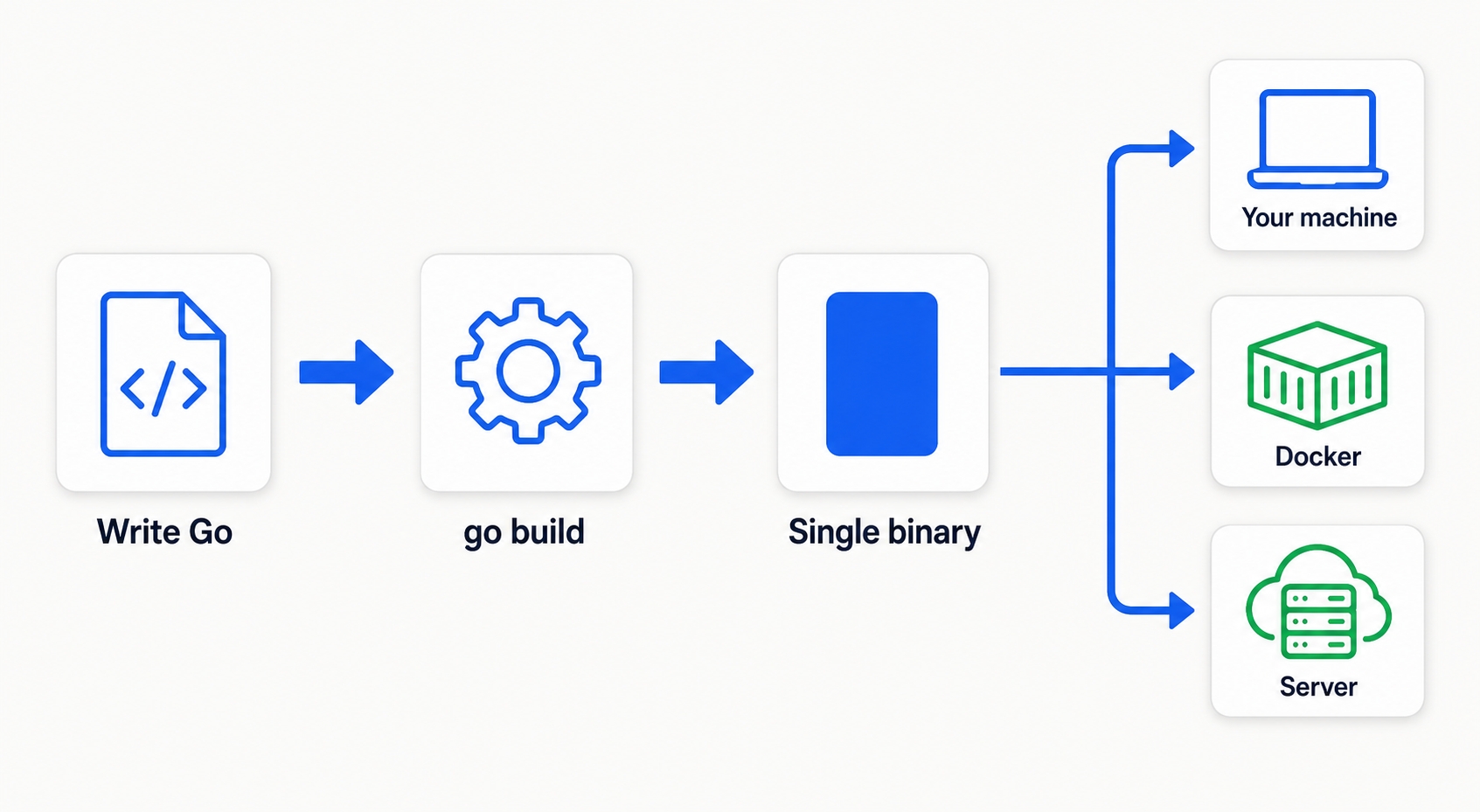
It compiles to a single static binary. When you build a Go program, the result is one self-contained file. There is no separate runtime to install on the server and no list of libraries to ship alongside it.

This sounds like a small detail, but it changes how you deploy. You build the binary, copy it to a machine or drop it into a container, and run it. Later in the course this is exactly what makes our Docker image tiny and our deployment simple.
The standard library already does the hard parts. Go ships with a strong set of built-in packages, often described as "batteries included." It includes everything you need to run a production web server, encode and decode JSON, and connect to other services, all without reaching for a framework. We build the entire Task API on the standard library, and you will see how far it gets us.
The performance is strong. Go is compiled and built with concurrency in mind, so it handles many requests at once comfortably. You will not need to understand all the internals to benefit from it, but it is reassuring to know the language you are learning is also fast enough for real production traffic.
This is the worry most beginners have, so let us answer it honestly. Go is not a hard language, and that is by design.
Because the language is small, there is simply less to trip over. You will not spend weeks fighting complex type gymnastics or memorizing rarely-used features. Most people who already code in another language can read basic Go within an hour and write useful Go within a few days.
Go does have a few habits that feel different at first. Error handling is explicit, so you will write if err != nil more often than you might expect. Pointers take a little getting used to. We cover both of these slowly and with plenty of examples when we reach them, so they will feel natural by the time you need them. None of it is hard; it is just new.
Here is the plan, so you know where we are headed.
We learn the language first. The next section covers the core of Go that a backend developer actually uses: variables and types, functions, structs, slices and maps, interfaces, errors, and a gentle first look at concurrency. We keep these grounded in small, runnable examples rather than abstract theory.
Then we build something real. The heart of the course is a Task API, a small web service for managing tasks that grows step by step. We start with a single HTTP handler that returns a greeting, add JSON endpoints, organize the code into clean layers, write tests, plug in a PostgreSQL database, and finish by packaging it for production with logging, configuration, graceful shutdown, and Docker.
By the end you will not just recognize Go syntax. You will have built a backend service the way it is done in production, and you will understand why each piece is there.
In the next chapter we look at what actually makes Go different from the language you already know, and we take an honest look at what Go is good at and where it is not the right tool.