In the previous chapter, we saw that Go stays small on purpose, and that single idea explains almost every difference you notice coming from another language. This chapter looks at the specific design choices behind Go and what they buy you when you build backend services.
The design philosophy in one line
Go's designers followed a strict rule: when there is an obvious way to do something, the language should offer exactly that one way and stop there. Most programming languages grow over time by adding features. Go grew by saying no.
That choice ripples outward into a few concrete goals:
Readability first. Code is read far more often than it is written, so Go optimizes for the reader. There is usually one idiomatic way to write a loop, handle an error, or format a file. Because of this, most Go code looks alike.
Fast builds. Compilation is quick even on large projects. This keeps the edit-build-run loop tight.
A small surface to learn. Go has around two dozen keywords, a handful of built-in types, and very little hidden machinery.
You might catch yourself wondering where ternary expressions or class inheritance are. When something feels missing in Go, it is usually deliberate. The creators left these features out to keep the language small and the code predictable. You might not always agree with those decisions, and that is fine. Knowing they were intentional choices rather than oversights makes the language easier to learn.
Compiled and typed, but it stays out of your way
If you are coming from Python, JavaScript, or Ruby, the first major difference is that Go is compiled and statically typed. Compiled means your code is turned into a machine-code program ahead of time, rather than interpreted line by line as it runs. Statically typed means the compiler knows the type of every value (like an int, a string, or a custom struct) before the program ever starts. This catches a whole category of mistakes at build time instead of in production.
This can sound like a lot of extra typing, and in some languages it is. Go softens the burden with type inference. You can write count := 0 and Go figures out that count is an integer. You do not have to spell the type out every time. You get the safety of static types without the heavy boilerplate that usually comes with them.
What Makes Go Different? Go's Design, Honestly | dalabs.academy
If you are coming from Java or C#, Go will feel lighter for a different reason. It is typed and compiled like those languages, but it skips the elements that make large codebases feel heavy. There are no deep class hierarchies to design and far less boilerplate. The result sits in a comfortable middle. It is as safe as a typed language, but quick to write like a scripting language.
Go is also garbage collected. You create values, and the runtime automatically cleans up the memory you are no longer using. You do not manually free memory the way you would in C or C++. For backend work, this is a highly practical default that you rarely have to think about.
The single static binary
This is the feature that changes how you ship software.
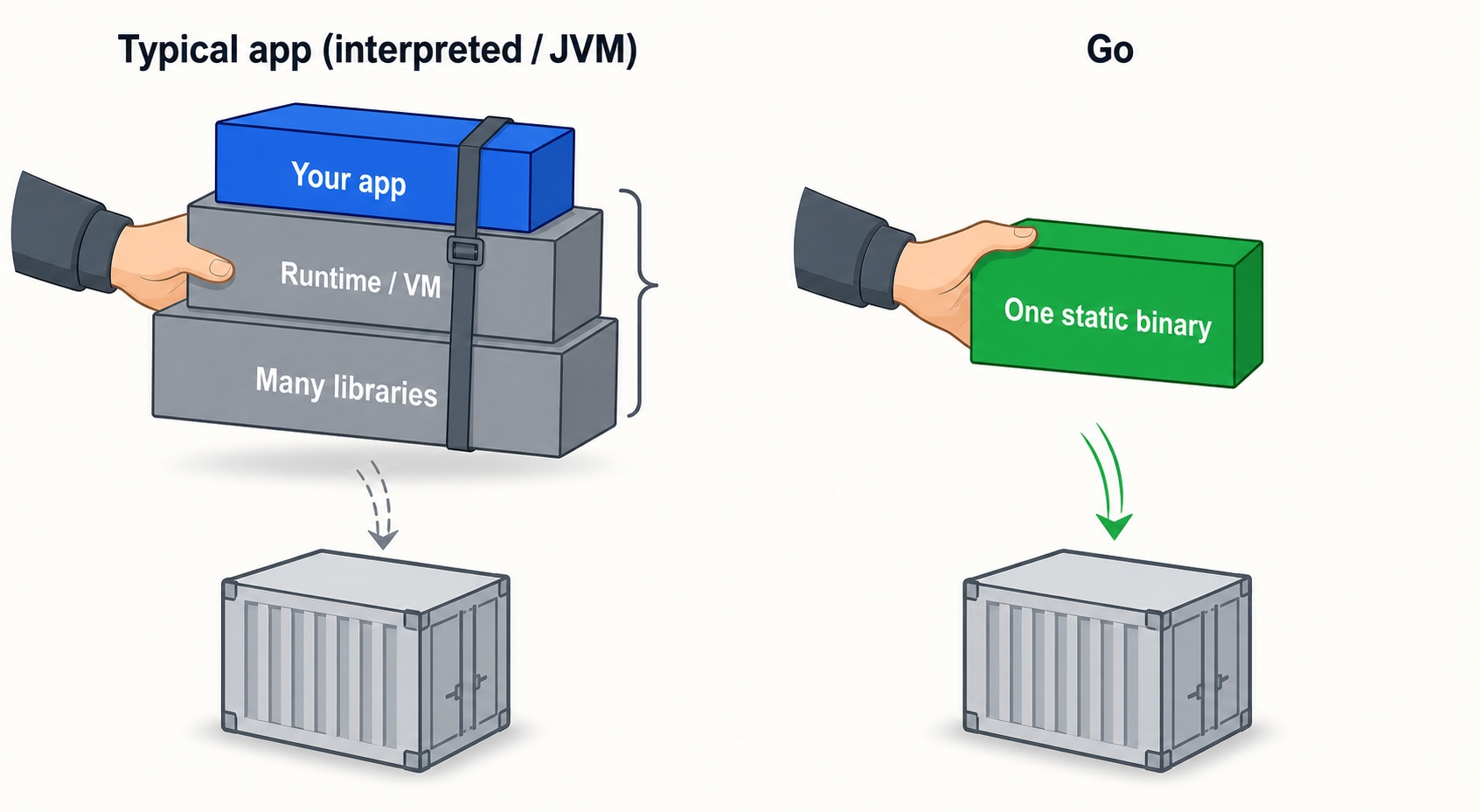
When you build a Go program, the output is usually one file called a static binary. Static means it bundles everything it needs to run into that single executable. This includes the Go runtime and any libraries your code depends on. There is no separate interpreter to install on the server, and no folder of dependencies to copy alongside your app.
Compare that to a typical interpreted or JVM application. To run it on another machine, you usually ship your code, the language runtime (like the Python interpreter or the JVM), and all the third-party libraries it imports. Those pieces must be present and at the correct versions, or the application will fail to start.
Go ships one binary; other apps ship app plus runtime
Here is why this matters in practice:
Deployment gets boring, in the best way. You build the binary, copy it to a server or drop it into a container, and run it. That is the whole story.
Docker images get tiny. Because there is nothing to ship but the binary, a Go service can fit in a container that is a few megabytes instead of a few hundred. When we build the Dockerfile near the end of the course, you will see an image that is mostly just our program.
Fewer "works on my machine" surprises. The thing you tested is the thing you ship, with no runtime version drift hiding underneath it.
Go binaries are static by default, but you can opt into dynamic linking in certain situations, such as when using libraries that call into C. For the kind of pure-Go backend service we build in this course, the one-file mental model holds true.
Concurrency is part of the language
Modern backends spend most of their life waiting on the network, a database, or a disk. To stay fast, a server needs to handle many requests at the same time. Concurrency is the ability to make progress on lots of these tasks at once. Go was built around this concept from day one.
In many languages, doing many things at once means reaching for an external library, a thread pool, or an async framework added on top of the language later. Go puts the tools in the language itself:
A goroutine is a lightweight task that Go runs concurrently. You start one by putting the word go in front of a function call. Goroutines are cheap, so a program can run thousands of them at once. Go's runtime automatically schedules them onto a small number of operating-system threads for you.
A channel is a typed pipe that goroutines use to send each other values safely. They allow goroutines to coordinate without you having to wrestle with manual memory locks.
The practical payoff is that Go's built-in HTTP server runs each incoming request in its own goroutine. You write your code as if it deals with a single request, and the server quietly runs many of them concurrently. We will look at goroutines and channels properly in the language section. For now, just know that handling heavy load is something the language helps with natively.
gofmt ends the formatting argument
Every team that writes code eventually argues about style. Tabs or spaces? Where do the braces go? How long can a line be? These debates burn time and settle nothing.
Go's answer is a tool called gofmt that formats your code to one canonical style automatically. It ships with Go, most editors run it every time you save, and the whole community uses it. The effect is that essentially all Go code in the world is formatted the exact same way.
For a beginner, this is quietly wonderful. You never have to decide how to format anything, you never get a code review comment about spacing, and any Go file you open online looks just like the code you write. It is one less thing to learn and one less thing to argue about.
What Go is good at
No language is good at everything. Here is an honest look at where Go fits best, starting with its strengths.
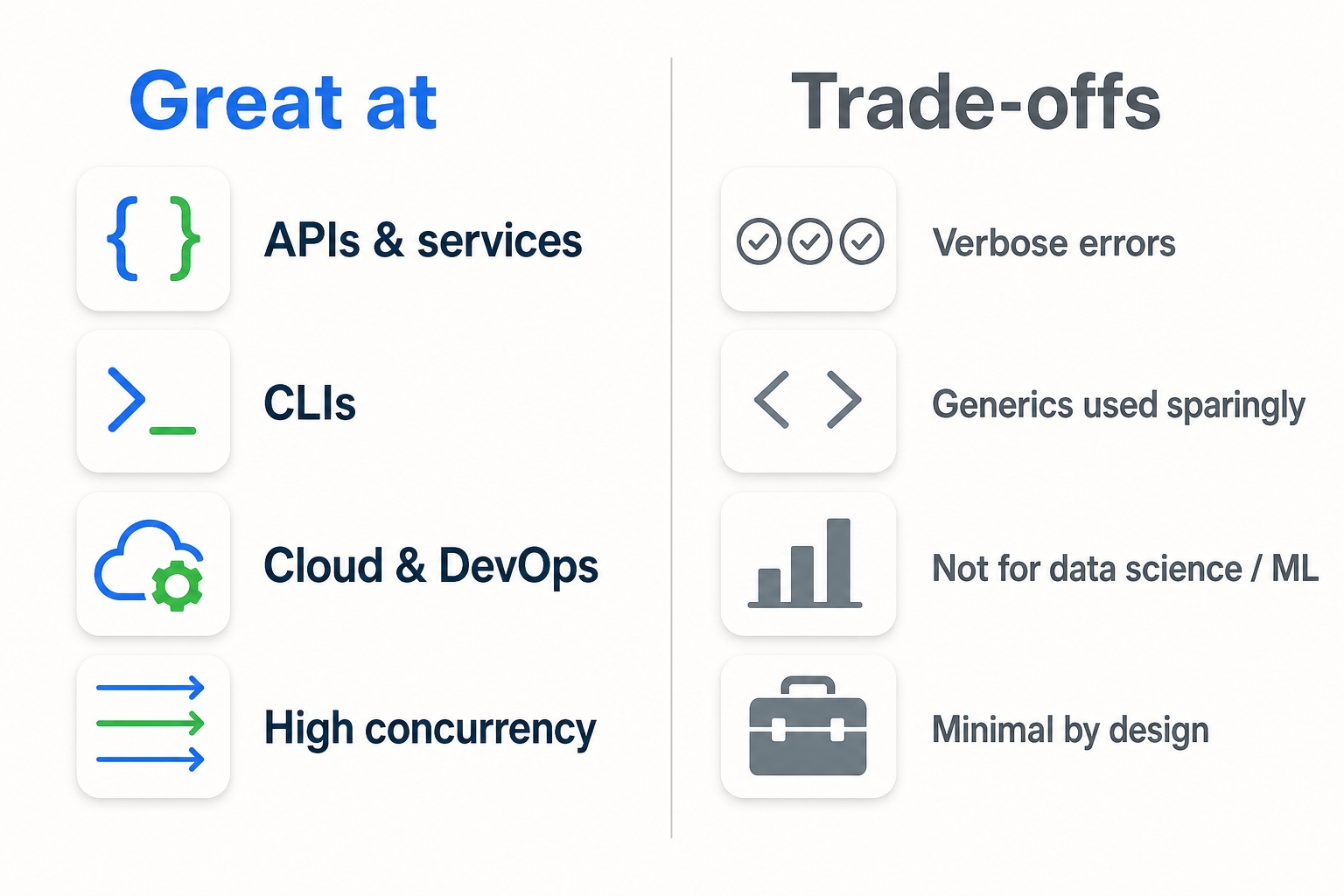
Go is an excellent fit for:
Network services and APIs. This is Go's home turf and exactly what this course builds. The standard library has a production-ready web server, JSON support, and an HTTP client built in.
Command-line tools. A single static binary with no runtime to install is perfect for a CLI you want people to download and run.
Cloud and DevOps tooling. Docker, Kubernetes, and Terraform are written in Go for a reason. It suits long-running infrastructure software.
High-concurrency servers. Goroutines make it natural to handle a lot of simultaneous connections without much fuss.
Anything where fast builds and easy deploys matter. Quick compiles keep you productive, and the single binary keeps shipping simple.
What Go is great at and its honest trade-offs
The honest trade-offs
Now for the other side. These trade-offs are real, and knowing them up front will save you frustration later.
Error handling is verbose. Go does not use exceptions for ordinary failures. Functions return an error value, and you check it explicitly. You will write if err != nil { return err } a lot. The upside is that every place something can fail is highly visible in the code, making Go programs easy to reason about. The downside is that it can feel repetitive at first. Most Go developers come to appreciate the clarity, but it is fair to find it noisy on day one.
Generics arrived late and are used sparingly. Generics allow you to write one function or type that works for many types. They only landed in Go 1.18, released in March 2022, more than a decade after the language launched. They work well, but the community uses them lightly rather than everywhere. If you come from a language where generics are central, Go's restraint here can feel limiting.
It is not the tool for every job. Go is a poor fit for heavy data science and machine learning, where Python's ecosystem dominates. It is also not a natural choice for desktop GUI applications. Picking the right tool means knowing where a language does not shine, and these are honest gaps.
The minimalism frustrates some people. The same small feature set that makes Go easy to learn can feel restrictive once you know it well. Developers who love expressive, feature-rich languages sometimes find Go too plain. Whether that is a strength or a weakness depends on what you value. For learning backend development and shipping reliable services, this simplicity tends to help far more than it hurts.
None of these trade-offs should scare you off. They are simply the cost of the design choices that make Go great at building backend services.
What's Next
You now know what makes Go different and where it fits. Next, we will take a bird's-eye tour of the Task API you will build across this course. This will give you a clear view of the destination before we start writing code.