Welcome to Chapter 7! Up until now, your code has lived entirely inside a single main.go file. That is perfect for small experiments, but real-world apps grow quickly.
To build clean, maintainable software, you need two superpowers:
Functions: To name and reuse chunks of code.
Packages: To split your code into organized folders that work together smoothly.
In this guide, you will learn how to write advanced functions, create your own packages, pull in external libraries, and master the single rule Go uses to handle code visibility.
What We Are Building
We are going to take our code and split it into two brand-new library packages: mathx and textx. Then, we will call them both from our main file, main.go.
mathx will teach you how to handle parameters, multiple returns, and flexible inputs.
textx will show you how to pull in and use outside libraries using go get.
Your Goals for This Chapter:
Write functions with multiple return values and flexible, "variadic" arguments.
Organize your code into custom folders (packages) and import them cleanly.
Control visibility using Go's capitalization rule.
Go Functions & Packages for Beginners | dalabs.academy
Want to jump straight to the finished code? Run this in your terminal:
git checkout 07-functions-and-packages-finish
1. Master Go Functions
Every basic Go function follows this exact blueprint: func name(parameters) returnType.
funcadd(a, b int)int{
return a + b
}
go
Pro Tip: Notice a, b int? When neighboring parameters share the exact same type, you only have to write the type once at the end. It saves you from writing a int, b int.
Returning Multiple Values
Unlike many programming languages, Go functions can throw back more than one value at the same time. This is used everywhere in Go—especially for error handling.
Let's look at a function that calculates an average, but might fail if you give it no numbers:
// mathx/stats.go
var ErrNoNumbers = errors.New("mathx: no numbers given")
funcAverage(nums ...int)(float64,error){
iflen(nums)==0{
return0, ErrNoNumbers
}
sum :=0
for_, n :=range nums {
sum += n
}
returnfloat64(sum)/float64(len(nums)),nil
}
go
When you call a function that returns multiple things, you catch them all at once using :=:
The Most Common Pattern in Go:
The if err != nil check is the golden rule of Go. If a function might fail, it gives you a result and an error. If err is nil, everything went perfectly. If err is not nil, something broke, the result is junk, and you need to handle the issue.
What if I want to ignore a return value?
If you pass no inputs to Average(), it triggers an error. Because the calculated number is meaningless during an error, we can throw it away using the blank identifier (_):
// main.go
_, err = mathx.Average()// We use '_' because we don't care about the float64 here
if err !=nil{
fmt.Println("Average() error:", err)
}
go
Named Returns (Self-Documenting Code)
You can also give your return values actual names directly inside the function signature:
// mathx/stats.go
funcMinMax(nums ...int)(min, max int){
iflen(nums)==0{
return0,0
}
min, max = nums[0], nums[0]
for_, n :=range nums[1:]{
min =smaller(min, n)
max =larger(max, n)
}
return min, max // Explicitly returning variables is clearest!
}
go
Why do this? It instantly documents your code. Anyone looking at (min, max int) knows exactly what those two returned numbers represent without reading the actual logic.
Note on "Bare" Returns: Named returns technically allow you to just type return without specifying variables. However, unless the function is tiny, it's always clearer to explicitly write return min, max.
Variadic Parameters (Infinite Arguments)
Look closely at the nums ...int parameter inside MinMax and Average. Those three dots (...) mean: "Accept as many arguments as the user wants to pass!"
You can call it with five numbers, zero numbers, or a hundred numbers:
min, max := mathx.MinMax(7,2,9,4,1)
avg, err := mathx.Average()
go
Inside the function, Go automatically packages those inputs up into a standard slice ([]int) for you to loop through.
Have an existing slice you want to pass? Simply add ... to the end of your slice variable to unpack it: mathx.MinMax(mySlice...).
2. Organizing Code with Packages
Think of a package as a labeled storage box. Everything inside that box can see and share code freely, but outside code can only use what the box explicitly allows.
The Golden Package Rules:
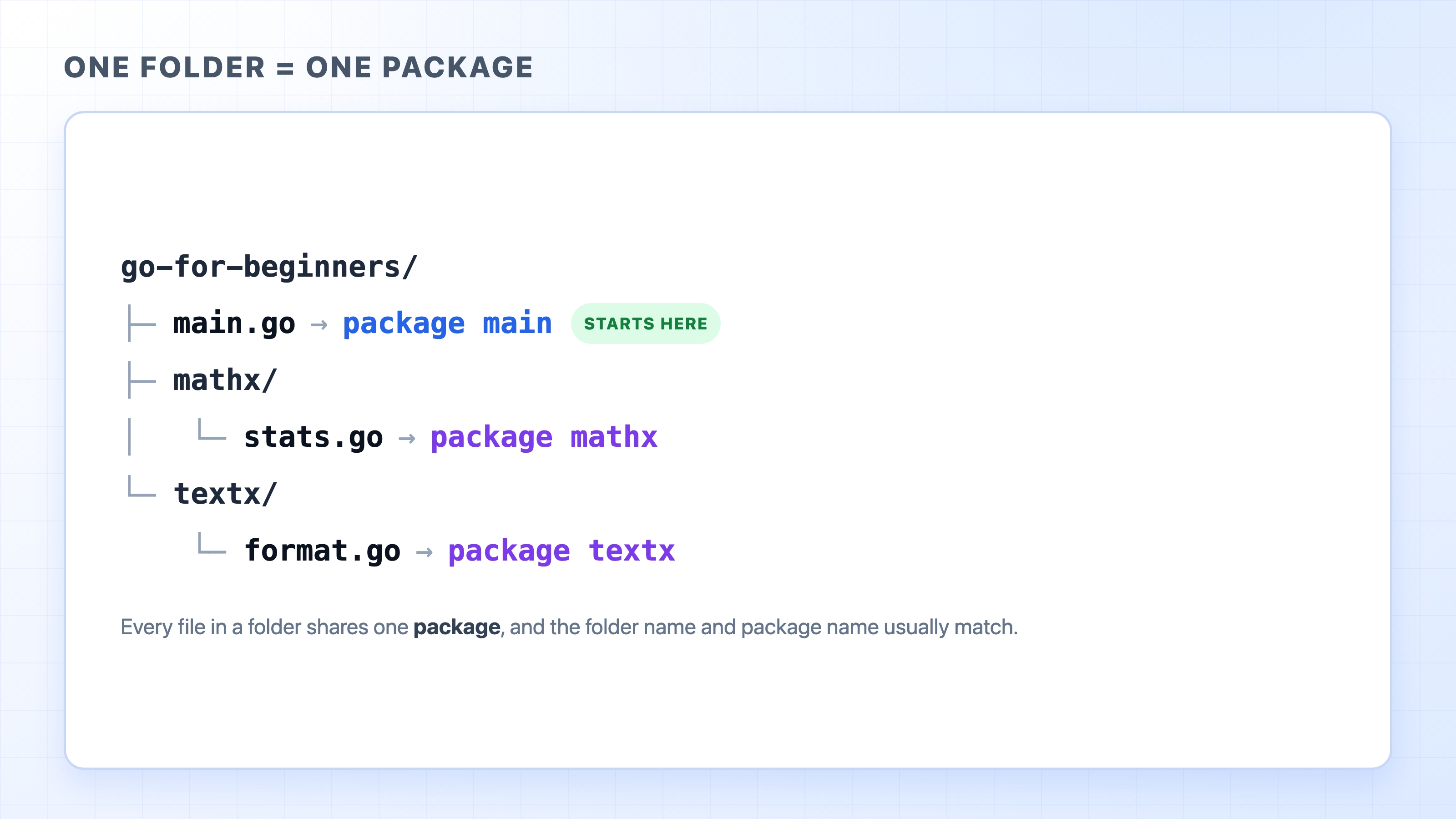
One Folder = One Package: Every single .go file sitting inside the same folder must declare the exact same package name at the top of the file.
Matching Names: While not a strict compiler rule, keeping your folder name and your package name identical (e.g., the mathx/ folder contains package mathx) makes your project incredibly easy to navigate.
Project Layout
Here is how our project directories are structured:
Directory tree showing one folder is one package
package main is special. It tells Go that this isn't just a library—it's the entry point where the program executes func main().
Linking Packages Together
To map your packages, Go relies on two pieces of information:
Term
What it is
Example
Module Path
The unique base "address" of your entire project (set up inside go.mod).
github.com/mt26691/go-for-beginners
Import Path
The base Module Path + the specific subfolder your package lives in.
github.com/mt26691/go-for-beginners/mathx
To use your custom libraries inside main.go, point your import blocks directly to their Import Paths:
// main.go
import(
"fmt"
"github.com/mt26691/go-for-beginners/mathx"
"github.com/mt26691/go-for-beginners/textx"
)
go
Once imported, call their functions by prefixing them with the package name:
min, max := mathx.MinMax(7,2,9,4,1)
label := textx.Label(" go clean code ")
go
3. Visibility: The Capitalization Rule
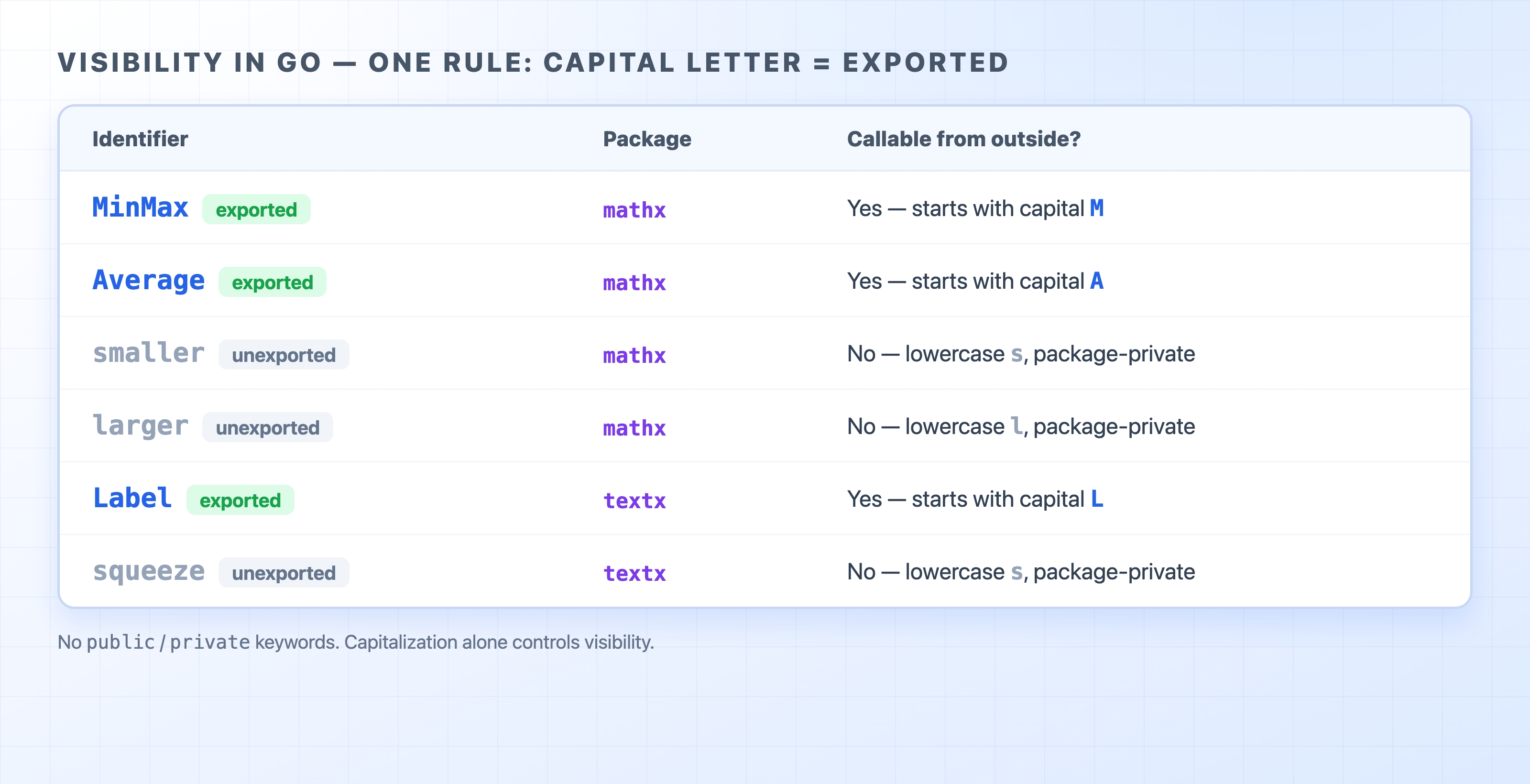
Go completely skips keywords like public or private. Instead, access control comes down to a single visual rule:
Capital Letter = Exported (Public). Other packages are allowed to use it.
Lowercase Letter = Unexported (Private). Only files inside the same package can use it.
Exported vs unexported identifiers across mathx and textx
Visibility Breakdown
Identifier Name
Type
Visibility
Can main.go see it?
MinMax
Function
Capital ➔ Exported
Yes
Average
Function
Capital ➔ Exported
Yes
ErrNoNumbers
Variable
Capital ➔ Exported
Yes
smaller
Function
lowercase ➔ Unexported
No (Compile Error!)
squeeze
Function
lowercase ➔ Unexported
No (Compile Error!)
This rule is universal across Go. It applies to variables, functions, types, constants, and custom fields.
Let's look at textx/format.go to see this in action:
// textx/format.go
funcLabel(raw string)string{
cleaned :=squeeze(strings.TrimSpace(raw))
return titler.String(cleaned)
}
funcsqueeze(s string)string{
return strings.Join(strings.Fields(s)," ")
}
go
Label can call squeeze easily because they both live inside the textx package box.
If you try to run textx.squeeze() inside main.go, Go will throw a compilation error because it starts with a lowercase letter.
4. Using External Dependencies
While Go has an incredible built-in standard library (like "strings" and "errors"), you will eventually want to use code written by other developers.
For instance, the built-in strings.Title was deprecated in Go 1.18 because it didn't handle non-ASCII characters well. The Go team provides a superior tool inside the external package golang.org/x/text.
How to Install External Code:
Open your terminal and run go get followed by the package path:
go get golang.org/x/text/cases
go get golang.org/x/text/language
bash
Running these commands does two things automatically:
go.mod Updates: Adds a require tracking line showing the exact version downloaded.
go.sum Creation: Generates a file containing secure cryptographic checksums to guarantee your downloads are safe and haven't been modified maliciously.
Note: Both of these files are managed by Go. Always commit them to version control, and never edit them by hand.
Implementing the Library
Now we can use the advanced casing library securely inside textx/format.go:
Now that our code is neatly split across main, mathx, and textx, run your application:
make run
bash
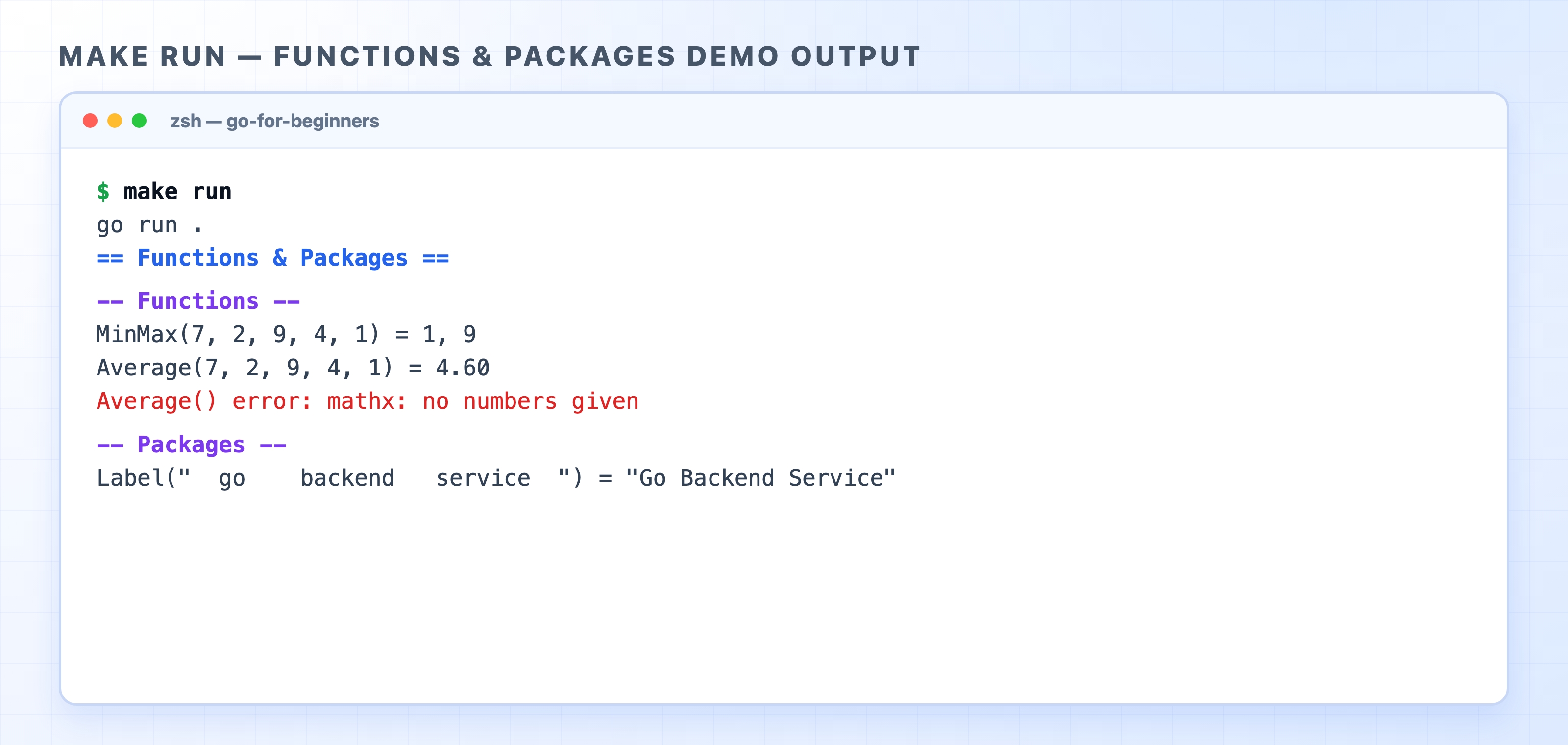
Expected Output
make run output showing the functions and packages demo
Look at how beautifully it works! Our empty Average() call safely surfaces our sentinel package error (mathx: no numbers given), and our Label call elegantly cleans up the messy spaced string into a clean title.
What's Next?
Now that you know how to package code and handle errors, we are ready to dive into control flow: if, for, and switch statements. Since you have already practiced the if err != nil pattern, the next chapter will feel like a natural next step!