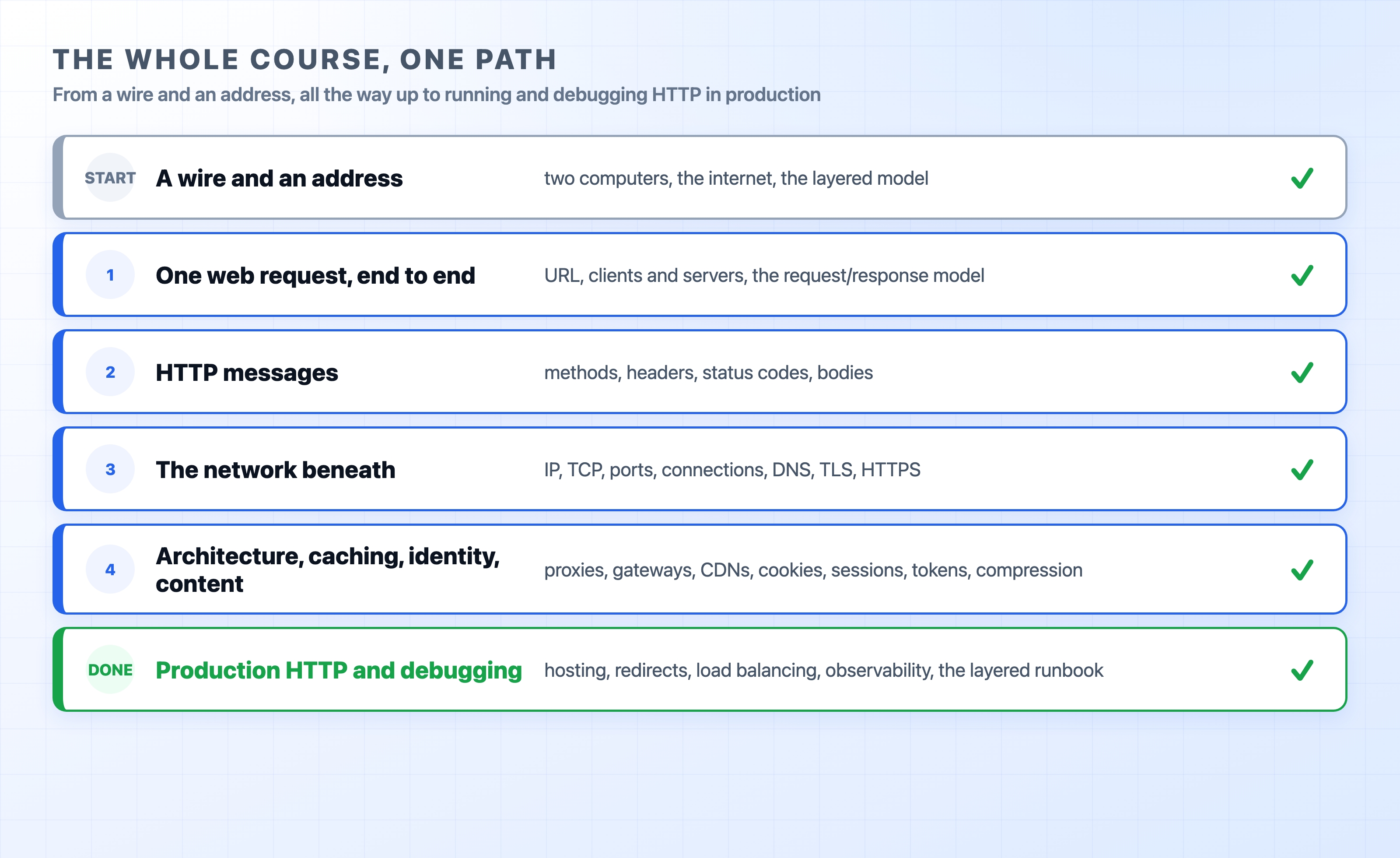
In the last chapter you walked a broken request layer by layer and found the bug without guessing. That was the final skill, and it's a good place to stop and look back. You started this course able to send an HTTP request. You can now follow one from the URL you type all the way to the bytes that come back, name every layer it crosses, and figure out which one broke when something goes wrong. That's a real shift, and it's worth seeing how far the path went.

We built this from the bottom up, on purpose, because each idea rests on the one below it. It's worth replaying the whole arc as a single trip rather than a list of chapters.
We started with two computers and a wire, and the simplest possible question: how does a stream of bits get from one machine to another, and how does each machine know where to send it? That gave us addresses, then switches and routers joining small networks into the internet, and finally the layered model that organizes the whole thing.
On top of that we put one web request. You learned what really happens when you open a website, what a client and a server are, and how a URL names a resource. Then we opened HTTP itself and read it line by line: the request line, the methods, the headers, the status codes, and the body underneath the blank line.
From there we went below HTTP to the network that carries it. IP gets a packet to the right machine, TCP turns that best-effort network into the reliable ordered stream HTTP assumes, ports and sockets pin a connection to a process, and connection reuse is why HTTP/1.1, HTTP/2, and HTTP/3 each feel faster than the last. Then DNS turned a name into an address, and TLS wrapped the whole exchange in encryption and trust to give us HTTPS.
With the request understood end to end, we looked at the machines it actually passes through: web servers, forward and reverse proxies, gateways, and tunnels. Then the systems built on top of all that, the ones that make the real web work: caching at the browser, the headers, and the CDN edge; cookies, sessions, tokens, and API keys that let a stateless protocol remember who you are; and , the Content-Type, negotiation, compression, and file uploads that move every kind of payload.
Finally we ran it for real. Production HTTP covered virtual hosting, redirects, load balancing, rate limiting, and observability. And debugging gave you the toolkit to find problems anywhere along that path, ending with the layered runbook you just used.
If you forget every header name and status code in this course, one thing should stay: HTTP sits on top of a stack of layers, and each layer has a clear job. A name resolves to an address. A connection opens. Encryption is negotiated. A proxy routes the request. Your app answers. That model is what the whole course was quietly building, and it's the part that lasts, because every specific fact you learned hangs off it.
That mental model is also what makes you useful when something is on fire. It turns a vague "the site is broken" into three concrete habits you'll keep reaching for:
curl to reproduce a request exactly, dig for DNS, openssl s_client for the certificate. Each one proves or clears one layer.Those three habits transfer to systems this course never touched. The protocol details change; working the layers in order does not.
You now have the foundation to read almost any networking material and follow it. A few directions are worth your time.
Go to the source. MDN's HTTP documentation is the reference to keep open; it's precise about every header, method, and status code. When you want the exact wording, the relevant RFCs are surprisingly readable now that you know the concepts: RFC 9110 for HTTP semantics and RFC 9112 for HTTP/1.1.
Go deeper on the protocol. Ilya Grigorik's High Performance Browser Networking is free online and is the best deep dive on TCP, TLS, and the HTTP versions, with the round-trip and latency numbers that explain why each version was designed the way it is. Cloudflare's Learning Center has clean, production-grounded explainers for DNS, TLS, CDNs, and HTTP/3 over QUIC when you want to push past what we covered here.
Build on what HTTP enables. Three areas grow naturally out of this course: web performance (Core Web Vitals, and using the timing breakdown you learned to make real pages faster), web security (CORS, CSP, and authentication in more depth), and observability (request IDs and distributed tracing to follow one request across many services). Each one is a layer up from where we finished.
If a topic here grabs you, the other dalabs.academy courses go deeper into performance, security, and backend systems, all standing on the same foundation you just built.
The fastest way to make all of this stick is to point it at something you already have. Open the Network tab on a site you work on and read the timing breakdown. Run the layered runbook against a real domain. Check a certificate, watch a cache hit, follow a redirect chain. The concepts move from "I read about it" to "I've seen it" the moment you run them on your own systems.
You came in seeing HTTP as a black box. You're leaving able to open it, read it, and fix it. That's the whole goal, and you got there. Go put it to work.