When I first started my career, I worked for outsourcing companies that used the Waterfall methodology. To me, the software life cycle felt incredibly long. It took months to move code from a development branch to staging, and finally to production.
The process usually looked like this:
Business Analysts spent months talking to clients to write a massive Software Specification.
Architects designed the system and agreed on a timeline.
Clients approved the budget and the specs.
The Team coded for months, then handed it over to QA for testing.
Release finally happened.
At first, this seemed solid. We agreed on everything upfront, and we had a QA team to ensure zero bugs. It sounded too good to be true.
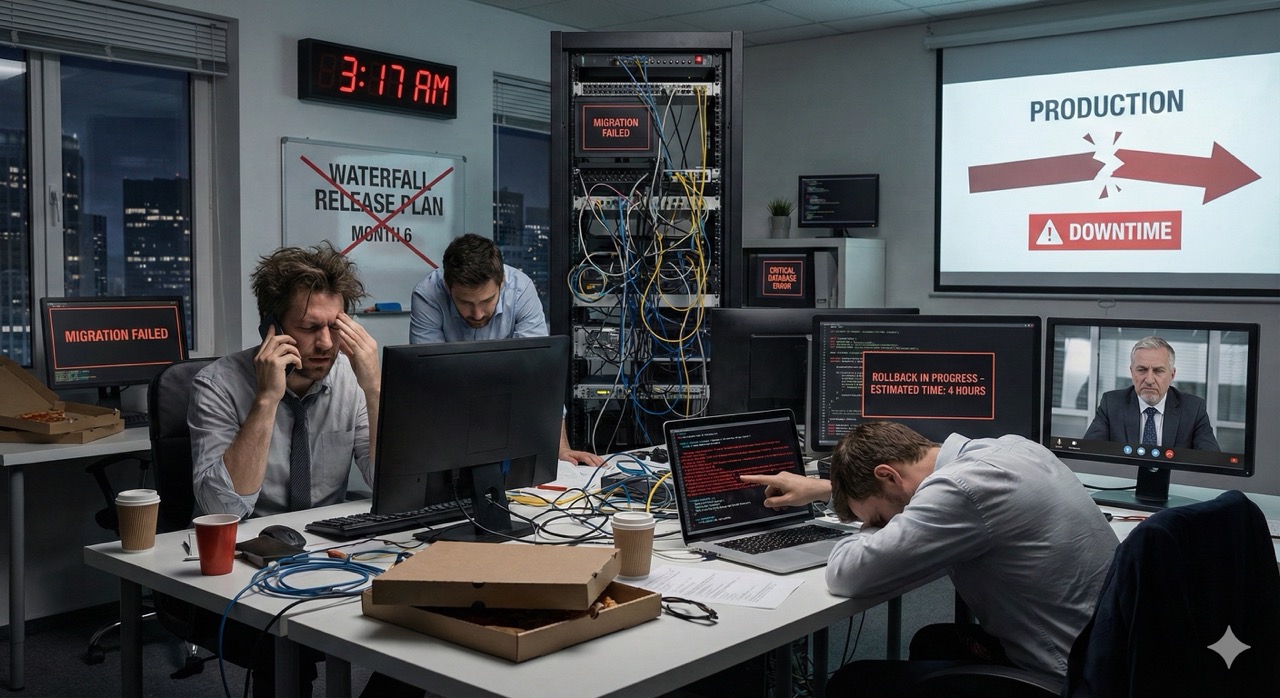
In reality, every time we wanted to release to production, it was a disaster. It meant the whole team working overtime—sometimes all night—to fix deployment issues.
We faced constant problems:
Migration Failures: Database changes worked on the development site but crashed on production. Rolling back took hours.
Fear of "The Difference": We were terrified that the production environment was slightly different from our testing environment. QA had to re-test everything manually.
Downtime: The application would go down for hours during the update.
Why did this happen? The root cause was the slow feedback system.
When production waits months to receive new code, you create a massive bottleneck.
Why do technical problems happen? When the "Develop" branch is 1,000 commits ahead of the "Main" branch, conflicts are inevitable. How can you ensure your database will migrate smoothly when the logic has changed so drastically?
Why do clients change their minds? Humans are bad at visualizing static specifications. When clients finally see tangible software after months of waiting, they realize it’s not what they envisioned.
If the bottleneck is feedback, we need to widen the pipe. What if we changed the way we work?
Release Daily (or Hourly): The difference between your dev branch and main branch is only 1 or 2 commits. Technical conflicts become tiny and easy to fix.
Fast Delivery: Clients see progress every day. If you are going in the wrong direction, they tell you immediately, not 3 months later.
No "Big Bang" Releases: You release small chunks. No more all-nighters. No more deployment trauma.
It sounds like a dream, right? So, how do we actually do it?
The "soft" in software means it should be easy to change. If it is hard to change, it’s just hardware. To build adaptable software, you need to combine five specific practices:
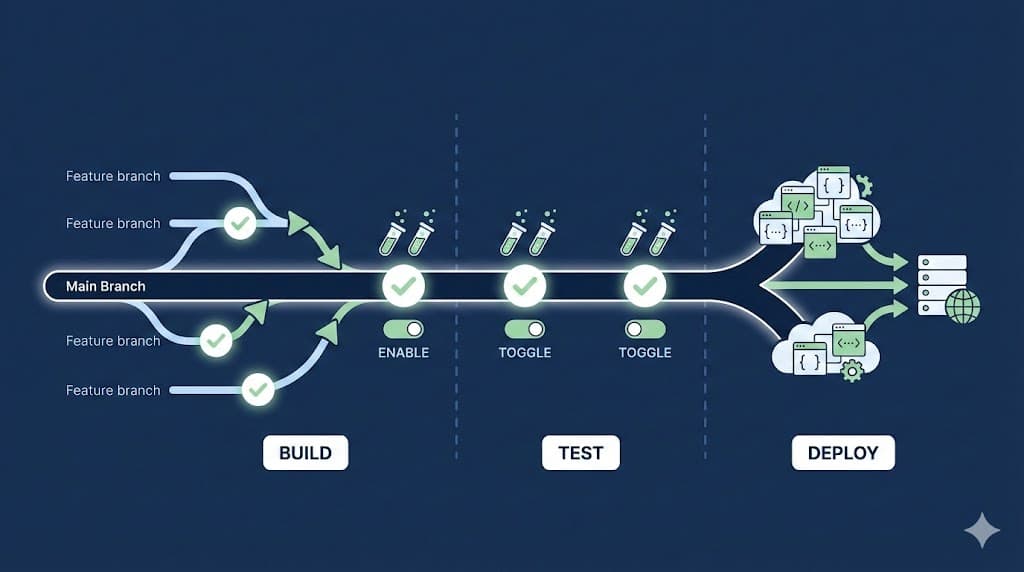
Trunk-Based Development
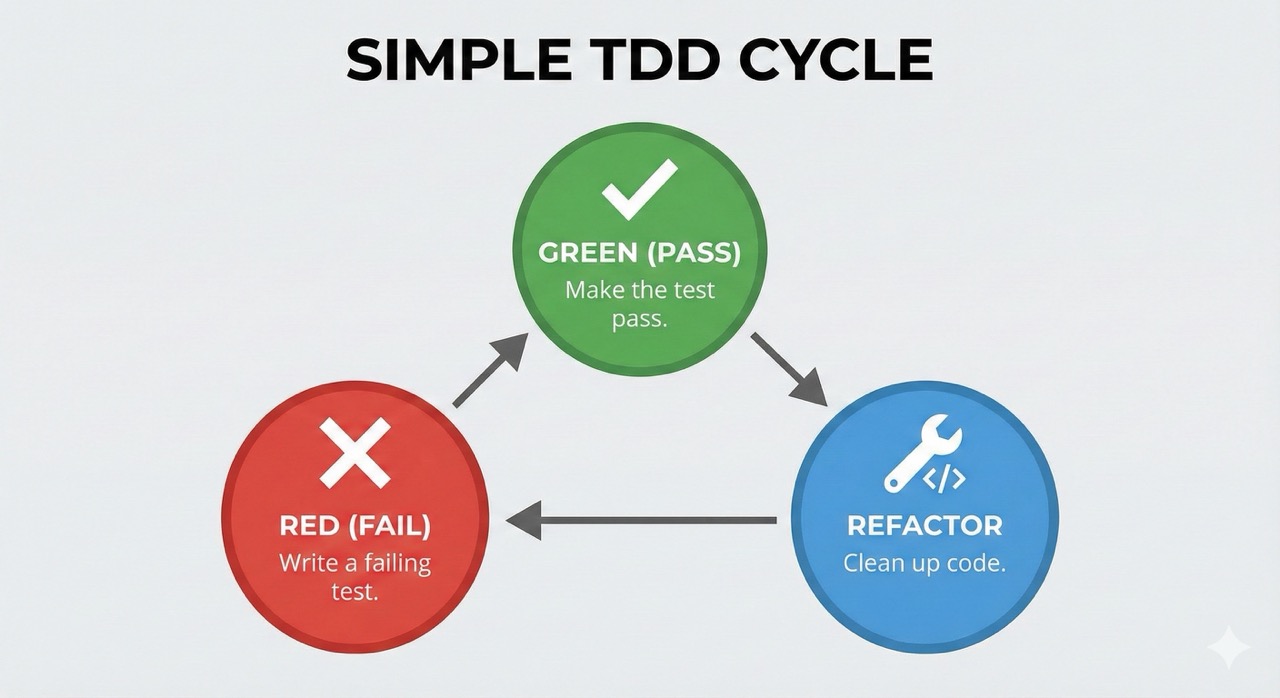
Test Driven Development (TDD)
Feature Flags
CI/CD Pipeline
Infrastructure as Code (IaC)
Here is how they work together.
This means creating "short-lived" branches. A branch should exist for a maximum of one day before being merged into the main codebase.
The Workflow:
An engineer creates a branch: feat/login-screen.
They work on a small chunk of the feature.
They open a Pull Request (PR) with a maximum of 250 lines of code.
It gets reviewed and merged quickly.
Why only 250 lines? If you open a PR with 10,000 lines of code, it is impossible to review properly. The reviewer will get overwhelmed and just hit "Approve" blindly. But if you have 250 lines, even a Junior Engineer can understand it and provide valuable feedback.
But how do you deliver a feature in small chunks without breaking things? You use TDD.
The Workflow:
Red: Write a test case for what you want the code to do. Run it. It fails (because the code doesn't exist yet).
Green: Write just enough code to make the test pass.
Refactor: Clean up the code.

Will this take more time? At first, yes—maybe 10% more time. But it saves you huge amounts of time later. The tests act as "living documentation" for other engineers. Plus, when a bug appears, you can write a test to reproduce it, fix it, and ensure it never comes back. Tip: With modern AI tools (LLMs), writing boilerplate test cases is faster than ever.
You might ask: "If I merge code daily, what if the feature isn't finished? I can't show a half-finished login screen to users!"
This is where Feature Flags come in. A feature flag separates deployment (putting code on the server) from release (showing it to users).
It is essentially a simple switch in your code:
javascriptif (FEATURE_FLAGS.ENABLE_LOGIN_FEATURE === true) {showLoginButton();}
You can deploy your code to production, but keep the flag set to false. The code is there, but the user doesn't see it. You can even enable it for only 50% of users (A/B testing). Tools like PostHog make this easy to manage.
Now that you have small branches and tests, you need to automate the process.
Continuous Integration (CI): Every time a developer pushes code to Git, an automated system runs. It builds the project, checks for syntax errors (linting), runs your unit tests, and scans for security flaws. If anything fails, the developer gets immediate feedback.
Continuous Delivery (CD): If the CI passes, the code is automatically packaged (e.g., into a Docker image) and deployed to a staging environment. In a fully mature system, it can even deploy directly to production automatically.
Finally, you cannot release daily if you are configuring servers by hand. "It works on my machine" is not an excuse.
Infrastructure as Code (IaC) replaces manual server setup with code. You define your database, your servers, and your networks in script files (using tools like Terraform or Pulumi).
This ensures that your Staging environment is exactly the same as your Production environment. No more surprises when you deploy.
If you combine these five pillars, you transform your team. You move from stressful, high-risk "Big Bang" releases to a smooth stream of daily improvements. You get faster feedback from clients, your engineers are happier, and you build software that is genuinely "soft"—easy to change and adapt.